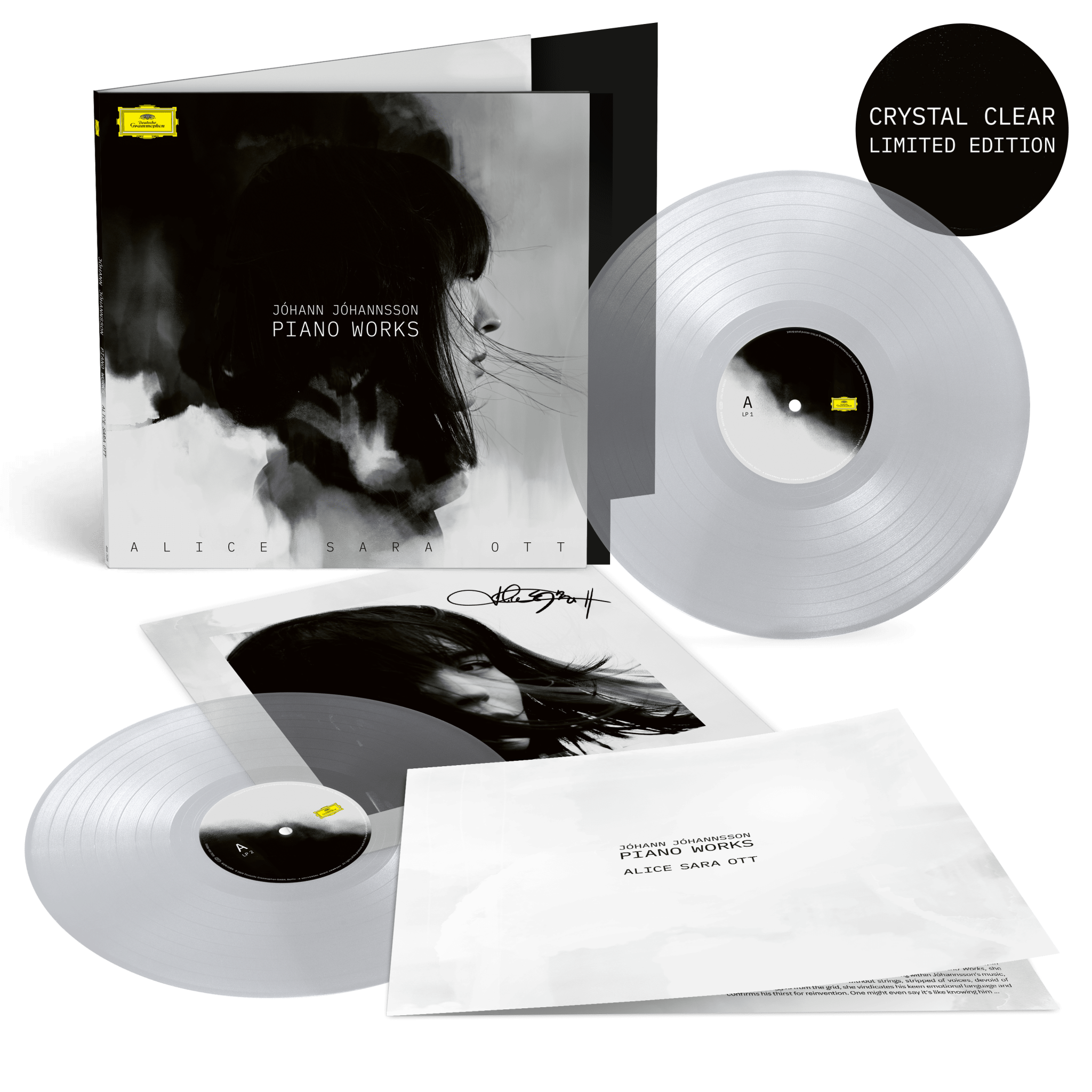

“I first became aware of Jóhann’s music in a conscious way with the film Arrival,” says Alice Sara Ott. “I am sure I had heard his work before without realising it, as he had already done so much by then. But it was with that film that I really became aware of how his music could make you feel things that can’t necessarily be created visually—those powerful feelings of claustrophobia and anxiety. I listened to him more and found that a lot of his music had this kind of urgency that I just loved.”
It was because of her passion for Jóhann’s music that DG approached Alice with Faber’s transcriptions of thirty of his pieces for piano. Entitled Jóhann Jóhannsson: Piano Works, the limited-edition project contains thirty pieces plucked from his vast oeuvre, which spanned music for film, television, theatre and dance. Included are selections from much-loved studio albums such as Englabörn and Orphée as well pioneering scores he wrote for documentaries and feature films such as Copenhagen Dreams, Personal Effects and the Golden Globe-winning The Theory of Everything.
At first glance, it’s a curious project for Alice, a 37-year-old German-Japanese classical piano virtuoso whose discography has largely embraced an impressive range of classic composers, including Ravel, Debussy and John Field, Beethoven, Brahms and Liszt. But it’s not the first time she has worked with contemporary classical artists; previous collaborations have included Bryce Dessner, Chilly Gonzales and Francesco Tristano, among others. It’s also not her first time working with a talented Icelander; back in 2015, she collaborated with Ólafur Arnalds on 2015’s wonderful The Chopin Project, whereby the pair reinterpreted some of the Polish composer’s pieces.
“I love Iceland,” she enthuses. “My first trip there was in 2008, to work with the Icelandic Symphony Orchestra, but that didn’t happen due to the crash. Then came Ólafur, who helped me break through some of the traditional walls that a classical education will give you. And then this project with Jóhann’s music came along. I was obviously interested and spent some time playing through the pieces to find out if it would work. I noticed along the way that I was hesitant because I never met Jóhann when he was alive. I wondered for a while if I was the right person. Then I realised I was being slightly ridiculous when you consider that I haven’t met most of the composers whose work I’ve recorded. So then it just became a question of whether the music spoke to me personally, and whether I could do it justice by bringing something to it.”
The answers to those questions are clear in the recordings, which have been given a remarkable and ethereal afterlife through Alice’s considered and gentle treatment. Stripped of their usual ornamentation (strings, electronics, brass), the melodies of compositions such as “Já, Hemmi Minn”, ”A Game Of Croquet”, “Odi Et Amo” and “The Sun’s Gone Dim And The Sky’s Turned Black” will be familiar to anyone who knows Jóhann’s music but with a more minimal, fragile feel that makes them sound like tender echoes of the originals. After Alice requested to work with Icelandic musicians that knew Jóhann, and to record there if possible, to get closer to his spirit, the sessions were recorded in the Reykjavik studio of Grammy-nominated producer and engineer Bergur Þórisson—one half of the band Hugar, as well as, in recent years, Björk’s musical director—who served as producer.
“I had actually worked with Bergur before on The Chopin Project, so we already knew each other,” she says. “His studio was dimly lit, an ideal warm and welcoming space, but Bergur himself is an incredibly safe and comforting presence. He has this calmness and doesn’t say unnecessary things at all. I feel very secure with him, which is an important feeling. In the end, I had a lot of freedom, but the really magical thing was that his studio had this old upright piano. As soon as I played it, everything just made sense. The instrument was perfect. Most of the recordings felt as if they were taking place inside a cloud.”
There were still some creative challenges to navigate: the first was to ensure that the sessions were reimaginings, rather than simply rerecordings, of Jóhann’s music. And as a corollary of that, there was the question of the relative simplicity of the music for a pianist used to navigating older, often more complex music. The process threw up some new and interesting questions. “Because the music is much slower and with fewer notes than I’m used to, I found myself asking myself things like: do I just play the notes as they are? Do I add the feeling they bring out in me? Add a little rubato? When you have minimal notes, you start thinking about the length, the breathing, the tension, the colours—suddenly you have more choices than you’re used to. But again this beautiful aged upright piano, and the melancholy and solitariness it somehow contained, helped me through. Without wanting to sound superstitious, there were moments when I felt that his music really was speaking to me. Of course, I don’t know if he would have agreed with the way I spoke in turn, but it also helped make it an intimate experience.”
With two digital EPs—Jóhann Jóhannsson: Piano Works—Film Themes and Jóhann Jóhannsson: Piano Works – From Englabörn already released and well received in 2025 and the full album—Jóhann Jóhannsson: Piano Works—released today, what kind of reaction to this unique project is Alice hoping for? “There are so many people who love Jóhann’s music and who like playing piano as a hobby or trying to learn, and I really hope people get inspired to play this music for themselves. I think the music is accessible and there is nothing better than loving a composer and being able to explore their music yourself. I felt I could enter a dialogue with him through this music and I really wish that others can have this experience. In a way, this is what music is about. It’s about the soul of a composer. There is the physical life that’s finite and there is an afterlife and it lives on in such different unique and versatile ways. Everytime someone picks up their work it becomes alive again in unexpected ways.”
Jóhann Jóhannsson: Piano Works is out now and available digitally, on CD and vinyl. Order now.