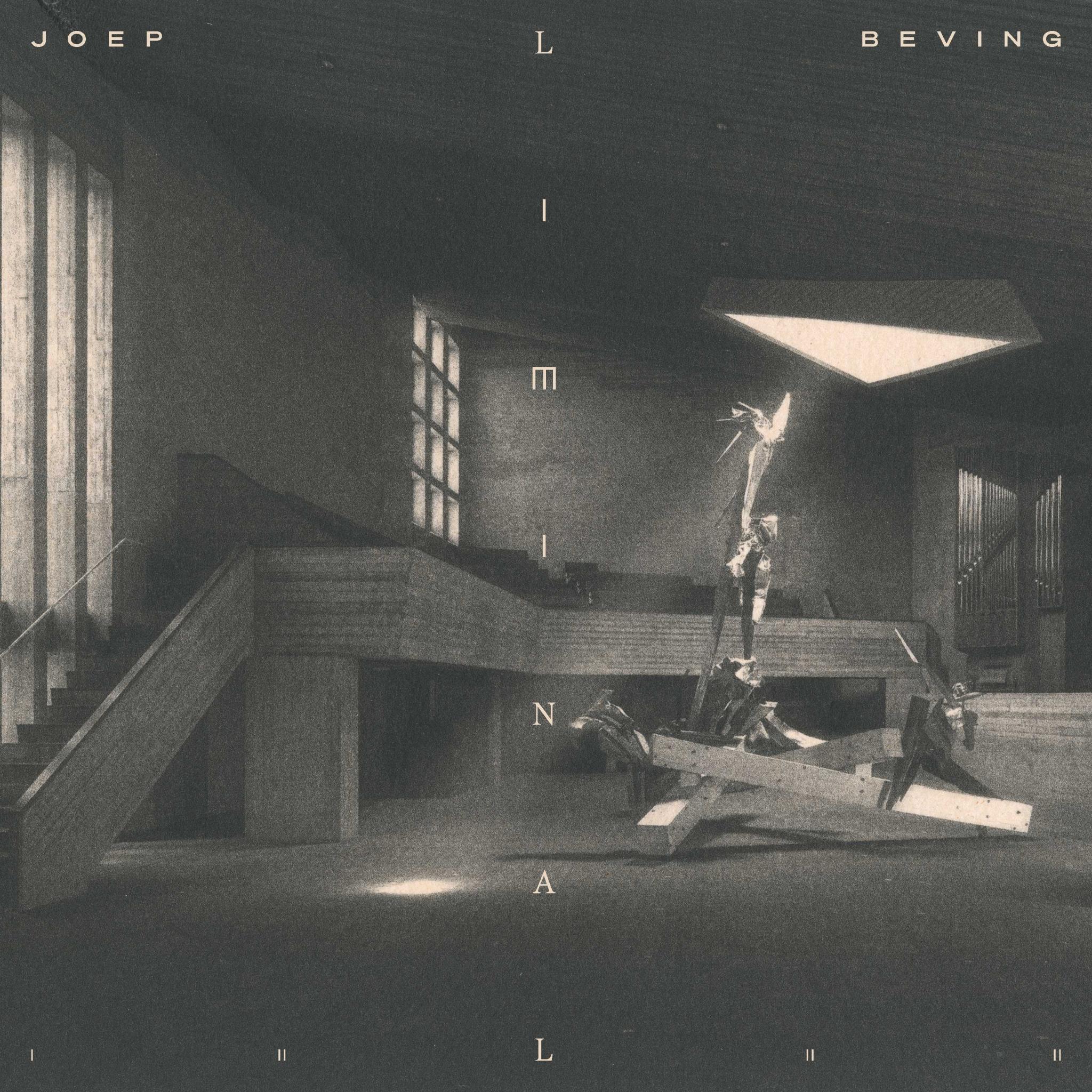
The final track on Joep Beving’s striking new album carries the amusing title: “Ghostly Chicken”. It’s intriguing for several reasons. Firstly, Beving is known for tackling serious subjects and weighty concepts (Liminal is no exception); secondly, almost all of the other fourteen compositions on the album have more earnest names (“Heterotopia”, “Incantation in B-Flat Minor”, “Elysium”…). And then there’s the sweepingly melancholic nature of the track, which doesn’t seem to quite fit such a jocular phrase…
“It’s a reference to Sir Francis Bacon,” smirks Joep after we have connected via Zoom. “He’s the man who is generally credited with institutionalising science, so to speak. Which is to say he took it out of philosophy and religion, and represents the point where the idea of magic or superstition sort of disappeared for us. He didn’t actually practice science but when he tried to, it was by shoving snow into a dead chicken to try to preserve it. In doing so he contracted pneumonia and died. Afterwards, the chicken was sighted in his village as a ghost….”
A curious anecdote that’s perhaps not so funny after all—but which connects to the concept on which the album turns, i.e. the tense and uncertain space that we humans find ourselves in today, confusedly existing somewhere between science, technology and nature, and wondering collectively what might be next.
In one sense, this exploration of the “in-between” can be seen as a continuation of Beving’s anthrocentric occupations to date. 2015’s Solipsism explored the self and its relation to others, 2017’s Prehension looked at collective experience, 2019’s Henosis dealt with ‘oneness’ and the nature of reality—but with the twist that humans are no longer the centre of the story; and might not be a part of it at all…
“It was very difficult to sit down and write something whilst full of anger, disbelief and fear about the world,” explains Joep of the project. “Many of us have been appalled at the way in which everything can be completely turned upside down in such a short time, and there’s a need to try and understand. It has made me incredibly sad, and I felt like I wanted to do something about it. One urge was to express the darkness I have been feeling, but I don’t think angry music would be enjoyable or would serve much of a purpose. So I waited for an opportunity to pull away and find a place from which I could observe and find some form of light; from where I could start looking for something beautiful again and detach myself from the anger and the heavy emotions.”
That moment came when Joep was on tour in Seoul (with Maarten Vos) and they visited an exhibition called Liminals by French artist Pierre Huyghe. Informed by conversations with quantum physicist Tommaso Calarco and philosopher Tobias Rees, the exhibition blurred the boundaries between body, matter and consciousness, giving rise to multiple possibilities of coexistence beyond the human realm—what Huyghe calls the “radical outside” of human subjectivity.
“There was so much to take in and it all kind of landed for me a couple of days later,” says Joep. “Especially the way it highlighted this possibility of existences that humans are not part of, or co-existences in which humans play a more humble role. It represents a move away from the concept of anthropocentrism, where humans are at the centre with their sickening desire to control nature and act like Gods at the material end of the spectrum. And it raised the idea of artificial intelligence, reminding me of Kurzweil’s singularity. This was an idea that used to scare me but at this point it could also be viewed not as the end of humanity but also as a possible coexistence. Rather than looking at the doom angle, what woud happen, for example, if AI were to take control but does it in a good way—a better way than humans would?”
The exhibition got Joep thinking and writing music, while the second slice of inspiration was served later in the shape of a book called Wild Renaissance by ecological thinker Guillaume Logé. Two of the three singles released from Liminal so far have titles borrowed from the book—the fragile and introspective “Wild Renaissance" and the soothing and unhurried “We are here but to make music and dance with all the obtaining forces”—which proved equally important for helping Joep break through the block.
“The book was given to me after the trip to Seoul, and tied in perfectly with the themes I had started working on,” says Joep. “Especially the way in which the author describes how objects or “events” that we perceive as dead or static might not be at all. He raises the possibility that we might just be incapable of seeing them in the right way. It’s this idea that our brain has been hijacked from its natural state and we have lost this alternative way of looking at the world. We’ve had this 300-year run of science and enlightenment but perhaps it’s time to go back. That sounds radical but actually it’s more retroactive. Both the exhibition and the book reminded me that intelligent solutions have always been present within everything around us, even before humans arrived. The challenge then becomes to find possible new paradigms and ways of looking at organisation, systems, and how to co-create with them…”
The most recent single perhaps sums up the philosophy of the album the best, or at least the most overtly. Titled "When humans do algorythms", it’s Beving’s most unique composition yet, an upbeat and busy blend of piano and electronics that carries the minimalist, repetitive air of Philip Glass or Terry Riley, representing a "dance" between human creativity and technology—and a potential effort to reconnect with nature. Joep has called this music “counterintuitive cyberoptimism” and made a video that visually overlaps digital binaries with references to the I-Ching as a playful allusion to the way seemingly disparate things can be combined, or might not even be as separate as we think.
“The music on the record is also a mix of the architectural and the ecological,” he reveals. “While making it, I realised parts of me wanted to respond to this liminal state in a traditional form that was conservative or nostalgic; that wanted to build essential structures where I could feel safe and where I was in control. But I also wanted to give up the idea that I'm the one deciding what these structures need to be, and to be open to having something else determine the outcome of a particular composition. This resulted in more improvisation and freeform writing than usual, for example with pieces such as “Wild Renaissance” and “Sfumato”, which are not quite songs or fully fledged compositions, but more like pieces of poetry that might be cut out of something else.”
With preparations underway for a tour that will take the Liminal music to stages around European and Canada (so far), I ask Joep what he hopes listeners will discover in his latest offering. “My aim has been to rebel with vulnerability and nuance. To provide a language that can be shared and a place where people can come together and recognise that we are not losing our minds. A place where we see that we're not isolated and that we are capable of rebuilding again…”
Liminal is out now and available digitally, on CD and vinyl. Order now.