
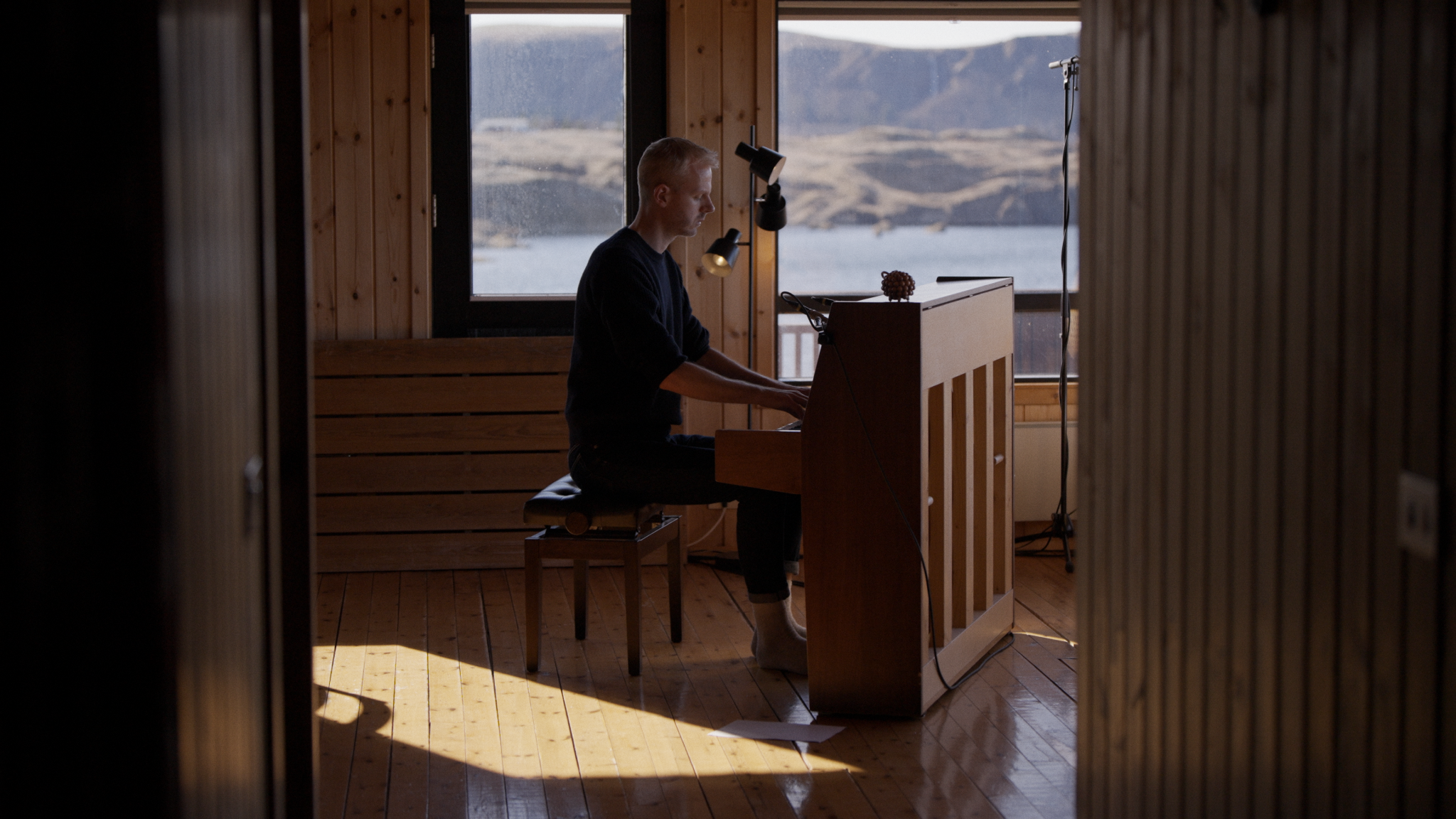
“One of the problems of being a melancholic Icelandic musician, which I obviously am, is that it can often feel that everyone outside Iceland wants to hear some kind of Icelandic essence through the music,” says Snorri Hallgrímsson. “They want to hear, or think they can hear, the people, the culture and the landscapes in the music, which is why you get these requests as an Icelander to record a concert, make a video or do a photoshoot on a volcano, inside an ice cave or in the middle of a lava field. I have felt this cliché ever since I followed Sigur Rós for their Heima project, and it is difficult to escape this feeling that your identity is somehow stripped away by the meaning others impose on you or your music. Of course, I have a career because of it too so I can’t be too judgemental but there is a conflict. The Nowhere Sessions are a way of trying to reconcile these contradictions by admitting it’s also part of who I am but doing so on my own terms…”
The difficult feedback loop between music, landscape and culture is not exclusive to Iceland but it is perhaps more pronounced there than with many other countries. Icelandic musicians since Björk have been routinely described as whimsical and full of elf-like eccentricity, their music as glacial or explosive (mirroring the “land of fire and ice” stereotypes), and their attitudes towards the industry as proudly independent—a consequence, clearly, of their Viking ancestry.
Snorri’s own brand of neoclassical composition, meanwhile—slow, meditative, thoughtful—is obviously reflective of the musician himself rather than his country; and yet he is also a product of his country. Snorri’s response to all this was to visit a place that some of his fans will already know: a secluded cabin in a part of the southern Icelandic countryside named Landbrot, which was also the name of his two-part EP project released in 2020-2021. Those recordings were actually made in Snorri’s Reykjavik studio as a tribute to a special place—but the Nowhere Sessions go one step further by actually recording live sessions there.
While the cabin is part of the local landscape, set atop a grassy hill at the edge of a lava field overlooking two lakes, it is also a deeply personal place for Snorri, somewhere that has been part of his family life since he was a child. “My grandfather bought the land that the cabin is on in the 1960s,” he says. “The intention was to build a summer house, but he sadly had a heart attack in 1973 before he could manage it. Afterwards, it became a bonding mission for my father and his siblings to finish the project. They enlisted the farmer who lived nearby, who was also a carpenter, and got the cabin built. It is still today a constant work in progress as there are always things to be done, and so it continues to be a family passion project. We all care so much about it. For me, I’ve been going multiple times a year since I was a kid and it always felt like a real refuge since I didn’t really fit in at school. By now it is a kind of sacred space, which is why I had to be very careful to only invite people I love and trust to record with me there.”
So it was that on an April day in 2026, Snorri and some of his closest musician friends—most of whom have worked with him on more than one of his previous studio albums—made their way to the cabin, armed with food, wine and instruments, including Snorri’s beloved studio piano. After a couple of days of eating, bonding and rehearsals, they spent a day playing and recording, with two friends filming the whole thing.
“For previous studio sessions we always recorded separately,” explains Snorri, “so it was such a beautiful thing to play all together with friends in the same room for the first time. We ate food and drank wine and the weather gods were good to us. It was sunny all day, which was very lucky because any rain or wind there is very loud and would have been completely disruptive since the cabin is so exposed. The only ambient sounds captured on the recordings are a bit of light wind, the occasional buzzing of flies in the room, and the sound of birds, which was perfect. We kept the recordings deliberately a little unpolished to keep it more authentic and true to the spirit of the project. The filming was the same: there are no sneaky edits of nearby ice caves or more dramatic landscapes, just what you can see from the cabin. I wanted it to feel low-key.”
During the sessions, Snorri also spotted a rare white fox out of the window. It didn’t make any noise but it did make it onto the album in the shape of closing song “The White Blur Was a Fox”, one of two new compositions, the other being the recent single “The Stars Will Dim”. The other seven songs featured on Nowhere Sessions are versions of “cabin-friendly”—i.e. slow and minimal—favourites from older albums, including “I Know You’ll Follow”, “I Am Weary, Don't Let Me Rest”, “Vorar”, “Sandlóa”, “Haustar” “Innocence” and “And I Alone”.
“The idea was always to record versions of older songs and to make something that is less a new studio album and more of an invitation to an intimate live performance where you can hear some music that you may have heard before. I personally love the studio and can spend days obsessing with the reverb tail of a single note—but this was very different for me, a deliberate mental exercise in letting go. It’s really a love letter to the venue and the personal meaning it holds for me. I won’t be turning it into a permanent workspace any time soon, but it was so much fun that I wouldn’t be against a different kind of project in the future… perhaps something with a choir, for example?”
Listen to Nowhere Sessions now.
Words by Paul Sullivan