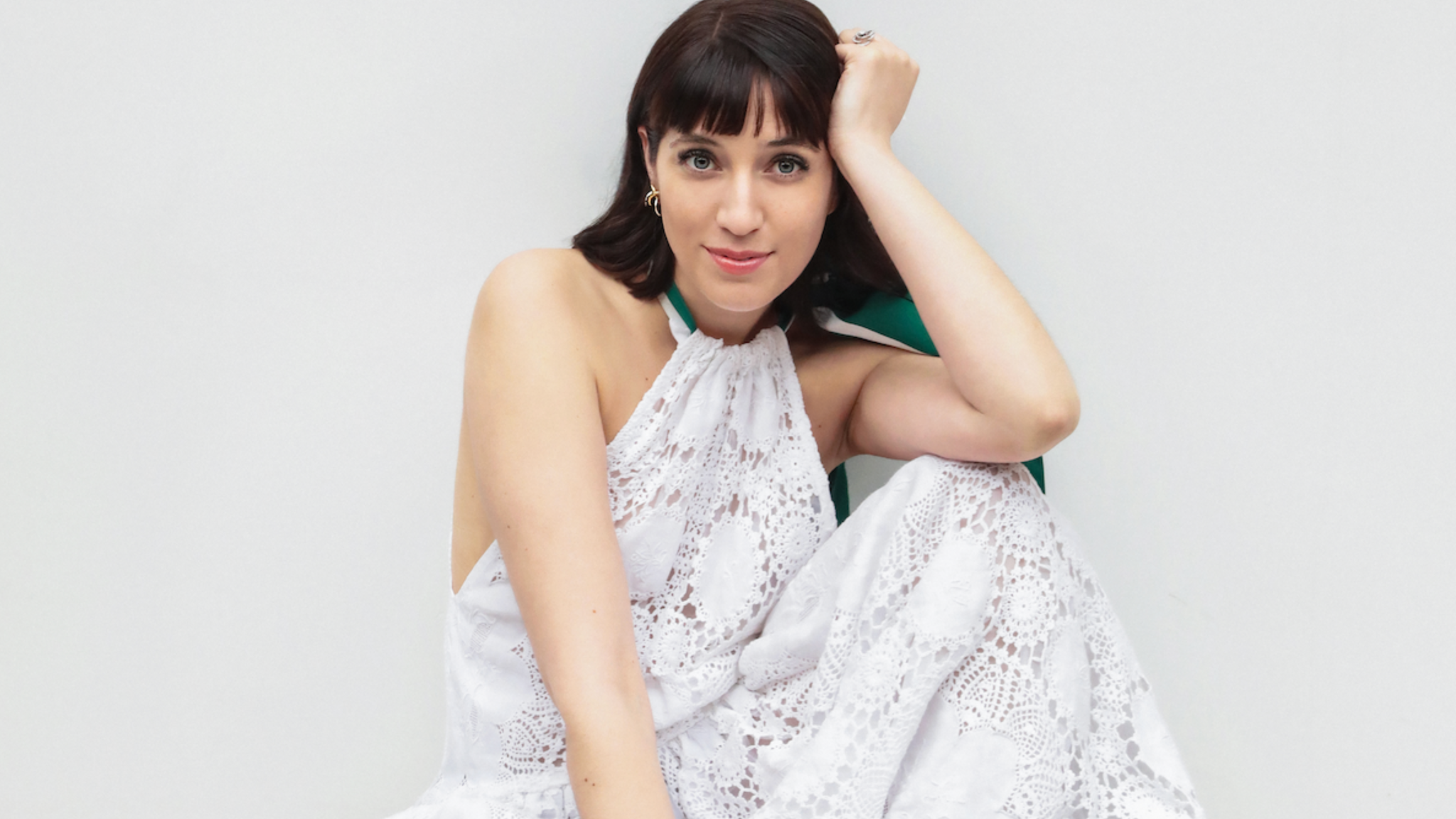
“It all started with my Voice of Hope album in 2020,” says a beaming Camille Thomas as we speak over Zoom from UMG’s Berlin offices. “I ended up adding two pieces by Philip Glass, both from Naqoyqatsi, at the last minute. I can’t really explain why; they just felt right for that project. And then a year or so later, I woke up to a message on Twitter from Glass himself, saying he really liked listening to the pieces and asking if I knew about his cello concertos. I couldn’t quite believe it! I honestly thought at first that it might be fake. But it wasn’t, so I checked his two cello concertos, met his manager a little later in Boston, and now here we are…”
Thomas’ latest release for the yellow label, to which she has been signed since 2017, is Philip Glass For Cello—a collection of reinterpreted Glass pieces that span not only his richly diverse cello concertos but also poignant arrangements of some of his film soundtrack work (including pieces from The Hours and The Truman Show), and several of his Études, transcribed for cello ensemble.
“The concertos definitely form the centrepiece of the recording,” explains Thomas. “I wanted to pay them a big tribute because they are not so well known, not even by myself as a professional cellist. The first one is quite simple, with three movements. It was premiered by the China Philharmonic during the 2001 Beijing Music Festival and I heard it was so good that the audience made the orchestra play the last movement again. The second concerto grew out of the music Glass wrote for Naqoyqatsi, a dark but very moving ecological film about how humans are destroying the planet. The original score is just 50 minutes long but very diverse across 11 very different pieces. It was originally recorded for Sony, who asked for a cello line to run through it for Yo-Yo Ma to play. It was then commissioned as a concert work with Matt Haimowitz on cello but narrowed down to just three pieces. I asked Glass and his management if I could play all 11; they showed a great deal of trust by saying yes…”
Even on first listen, it’s immediately clear that Philip Glass For Cello is a masterly and important recording—and that impression deepens with repeated exposure. Thomas flows between bold takes on Glass’s original material, especially the second concerto and the Études and more subtle rearrangements such as the reflective “Truman Sleeps” from The Truman Show and the melancholic “The Poet Acts” from The Hours, which starts the album on its emotive journey. Set for release around the composer’s 90th birthday (end of January, 2027), the album confirms Thomas’ virtuoso talents as well as underlining Glass’s natural diversity as a composer, taking the listener way beyond his known reputation as a proto-minimalist.
“My problem is that I am very passionate and often want to record everything,”
she laughs. “That’s how The Chopin Project became a triple album. Glass’s concertos already made one album but I really wanted to try to transcribe some of his Études to cello, which I had also done with Chopin and thought it worked really well. I could see how a cello ensemble could bring new light and more lyricism and power to these short piano pieces. Not that the transcription was easy. But I worked on those with Oscar Jockel, who had this sublime idea for “Étude No. 2” to try and replicate the piano pedal aspect of the originals by dividing the notes between different cellos that then hold each note so that they become layered. It brings something different but it is also true to the originals—as Glass himself obviously believed since he approved them.”
Elsewhere on the album, Glass’s “Étude No. 16” becomes an exercise in mellifluous elegance, the already passionate “No. 6” gains additional bombastic power from its orchestral backing, and “Symphony for Eight” builds into something resembling a trance state as the instruments overlap and coalesce (“I find it resembles something like techno,” states Thomas). By contrast, “Truman Sleeps”—a piece that has stuck with her ever since watching The Truman Show and which features Jockel on piano—has been softened and withdrawn even further into a sense of gentle intimacy.
The cover of the album is worth mentioning too: it features the artist in a striking red dress in front of “La Vague” by Jean-Michel Othoniel, a monumental wave-like sculpture composed of glass bricks. It was chosen by Camille precisely to reflect Glass’s music and its sense of continuous movement, its “ability to unfold, reform, and renew itself endlessly.”
“I do think Philip Glass influenced the entire 20th century in terms of music,”
she concludes.“He studied after all with Nadia Boulanger, who was well known for teaching her students, including Astor Piazzolla, Quincey Jones and Daniel Barenboim as well as Glass, not to repeat the past—to be themselves and create their own language. And he not only dared to invent his own language but his humanistic vision is also very inspiring. It is true that his master stroke was to express his music within the famous idiom of “less is more”, and for sure he influenced all of today’s neo-classical composers. But he is more than that. Glass can make you feel everything that music can do, whether that is being calmer, being bigger, being more…everything! It is hard to explain but Philip Glass is the composer that goes best with life.”
by Paul Sullivan